
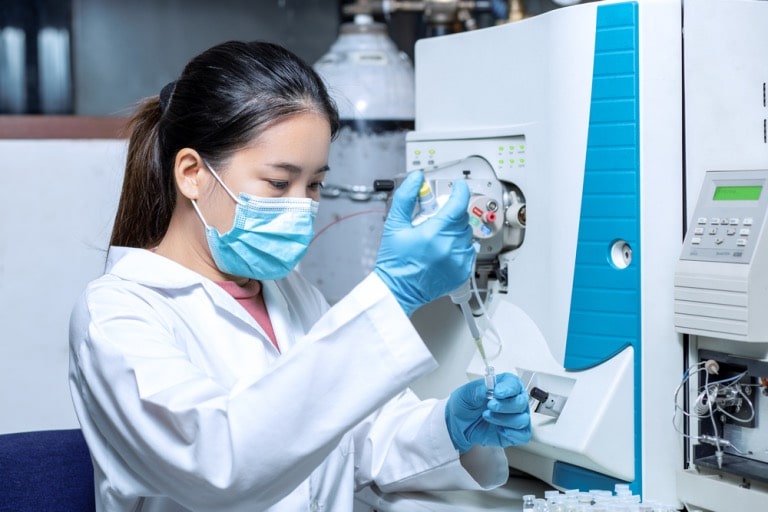
Undoubtedly, atomic absorption spectroscopy has become an indispensable analytical technique in various fields today, from environmental monitoring to material science. Atomic Absorption spectroscopy is a method wherein the detection and measurement of trace elements can easily and satisfactorily be done.
This article will help you understand the fundamentals and techniques of atomic absorption spectroscopy.
Absorption Process and Spectrometer Components
The principle of atomic absorption spectroscopy is based on the atom’s unique feature of absorption when put into a high-temperature source like a flame or graphite furnace. When this happens, several atoms of the analyte will be excited and hence able to absorb light radiation of a specific wavelength.
Here is a list of the atomic absorption spectrometer’s key components:
1. Light Source
A hollow cathode lamp or an electrodeless discharge lamp emits radiation at a wavelength specific to the elements being determined.
2. Atomizer
The part where the sample is converted into fine droplets or vapor, enabling the atoms to be excited and absorb light.
3. Monochromator
A device that filters out the wavelength of interest that is isolated by the element being analyzed for its absorption, while rejecting the rest.
4. Detector
Measures the amount of light absorbed by the sample, relating directly to the concentration of the element that is being tested.
5. Signal Processing and Display
This is responsible for the processing of detector signals and converting it to a readable format; for example, a value of concentration, and displaying the results.
3 Sample Preparation Methods
1. Dissolution
Samples that are solid need to be dissolved in appropriate solvents or acids for the analyte to be brought into the solution.
2. Dilution
Highly concentrated samples need to be diluted for it to fit within the instrument’s linear range.
3. Filtration or Centrifugation
The process wherein particulates and suspended matter are removed from the sample to avoid and prevent interference.
3 Common Calibration Methods
1. External Calibration
A process where various standard solutions are used to generate a calibration curve.
2. Standard Addition
A known amount of analyte will be added to the sample and the change in absorbance will be measured to determine the original concentration.
3. Internal Standardization
Both the sample and standard will have a known amount of different elements added to them to compensate for their matrix effects.
Application of Atomic Absorption Spectroscopy in Industries
Atomic absorption spectroscopy is applied in environmental analysis, pharmaceuticals, mining and metallurgy, food and beverage analysis, forensic science, and material science. Additionally, it has become one of the versatile tools ensuring safety, compliance, and quality for various industries.
This tool detects and measures heavy metals and toxic elements in environmental samples, ensuring that regulations related to these are complied with. It also measures the concentration of elements within drug substances and finished products to ensure their safety and efficacy in pharmaceuticals.
In mining and metallurgy, atomic absorption spectroscopy determines the elemental composition of ores and refined metals to provide proper extraction and processing techniques. It measures mineral content in food and beverage analysis, helps in nutrition labeling, and ensures food safety requirements.
Advancements in Atomic Absorption Spectroscopy
Companies like Agilent are getting out front with innovative atomic absorption spectroscopy instrumentation that really is changing the face of analytical chemistry. In fact, Agilent atomic absorption spectroscopy aims to focus on enhancing sensitivity, selectivity, and efficiency.
Having these features allows a more accurate measurement even in complex samples. Another advancement in AAS is the fast sequential mode which enables rapid, sequential measurement of various elements in a single sample.
Fast sequential mode increases the full-speed analysis by several factors, enhancing overall output. All these developments have definitely widened AAS applications in various industries.
A Catalyst for Innovation
Having atomic absorption spectroscopy as a driving force of innovation, the potential for analytical chemistry becomes limitless and ready to transform. As this technique evolves, researchers, manufacturers, and problem solvers alike are in for a powerful transformative technology.
